

International Desk
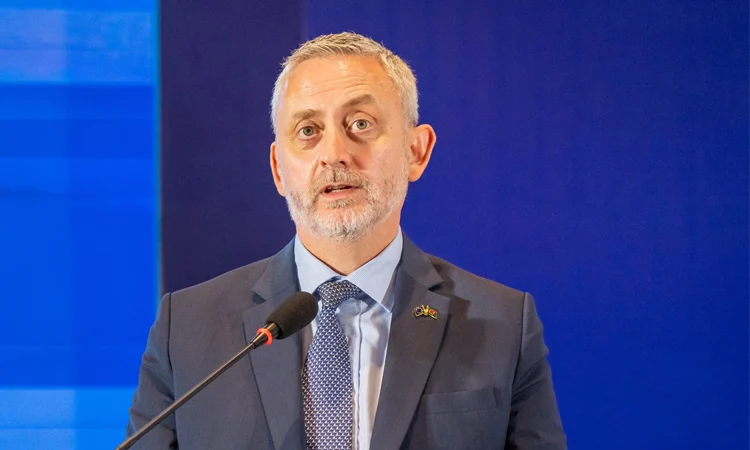
European Union Ambassador to Bangladesh, Michael Miller, expressed optimism regarding the conduct of a free and fair election in Bangladesh, emphasizing the country’s opportunity to demonstrate resilience against the global trend of democratic backsliding. His remarks followed a meeting with the Chief Election Commissioner in Dhaka on Monday morning, ahead of the 13th National Parliamentary Election scheduled for 2026.
Addressing journalists, Ambassador Miller highlighted that all stakeholders should prioritize the possibility of conducting credible elections, marking a significant moment for Bangladesh to reset its international reputation and reaffirm its democratic credentials. He stressed that the upcoming polls present an opportunity for the country to manage the electoral process in a professional and transparent manner.
Miller acknowledged the Election Commission’s proactive approach in addressing potential logistical and administrative challenges associated with the polls. “We see that the election commission is thinking ahead about all the possible complexities on the day itself and they are taking all the mitigating measures that we can imagine,” he said, adding that he remains “very optimistic” about the process.
The EU ambassador further noted that while the election schedule has not yet been officially announced, the Union is prepared to continue its support for what is expected to be Bangladesh’s first fully democratic election in several years. He emphasized the EU’s commitment to supporting timely, participatory, and smoothly conducted elections, describing them as a strategic opportunity for Bangladesh to redefine its democratic trajectory.
During the visit, Miller observed a mock exercise conducted by the Chief Election Commissioner, designed to ensure the commission’s preparedness for the simultaneous conduct of the general election and a referendum on the July charter. He expressed appreciation for the commission’s meticulous planning and logistical foresight, underlining the professionalism and capacity of the Election Commission to manage large-scale electoral events.
Highlighting the EU’s involvement, Miller revealed plans to deploy a substantial election observer mission to Bangladesh to monitor what is projected to be one of the largest democratic exercises globally in 2026. He described this deployment as a demonstration of the EU’s confidence in the electoral process and its support for Bangladesh’s diverse electorate.
Regarding challenges, the ambassador noted that a significant portion of the population, including a generation of citizens who have never previously voted, may face logistical and procedural uncertainties on election day. He emphasized the importance of voter education and preparedness to ensure smooth participation in both the general election and the referendum.
The EU delegation visiting the Chief Election Commissioner’s office included Deputy Head of Delegation Baiba Zarina, First Secretary (Political) Sebastian Riger-Brown, and European Commission Policy Officer Jules Seitz, accompanying Ambassador Miller during the engagement.
The meeting and subsequent statements underscore the European Union’s commitment to supporting Bangladesh’s democratic process, reinforcing the importance of electoral integrity and the professional management of national elections. The 2026 polls are expected to serve as a key benchmark for democratic governance and international credibility for Bangladesh.