

Top News Desk
Prime Minister Tarique Rahman on Tuesday issued an urgent call to the international community to honor climate commitments, emphasizing that millions of lives remain at risk due to global environmental degradation.
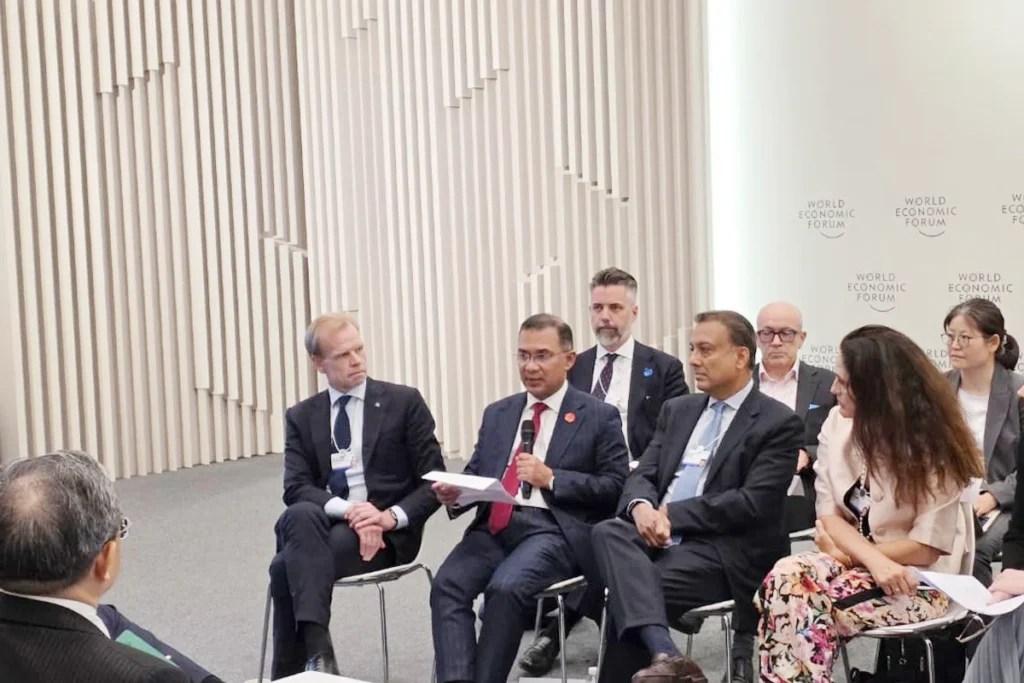
Speaking at the opening session titled “Climate Leadership in a Shifting Global Landscape” during the World Economic Forum’s (WEF) 17th Annual Meeting of the New Champions, held at the Dalian International Conference Center, the Prime Minister stressed the need to transition immediately from theoretical promises to measurable field actions.
The high-level summit, commonly referred to as “Summer Davos,” has convened over 1,700 global leaders, policymakers, and academics to deliberate on innovation and sustainable growth models amid shifting geopolitical and economic conditions.
Prime Minister Rahman underscored that the upcoming 31st United Nations Climate Change Conference (COP31), scheduled to take place in Turkey this November, must serve as a critical turning point to reaffirm the statutory frameworks established under the United Nations Framework Convention on Climate Change (UNFCCC) and the landmark Paris Agreement. He described the WEF as an essential multilateral platform for building consensus and facilitating collective cross-border strategies.
In his address, the Prime Minister challenged the conventional economic perspective surrounding environmental preservation, asserting that Bangladesh views systematic climate action not as an economic liability, but as an indispensable investment for long-term regional stability, economic prosperity, and security. Because climate vulnerability transcends national borders, he noted that building comprehensive resilience demands structured global partnerships, technological transfers, and reliable international financing mechanisms.
Outlining Bangladesh’s strategic diplomatic position ahead of COP31 and COP32, the Prime Minister highlighted three core global priorities. First, he stated that the Loss and Damage Fund must transition from a symbolic commitment into a fully operational entity that offers predictable and easily accessible financial assistance to frontline climate-victim nations.
Second, he called for international climate finance to become significantly more concessional and directly responsive to the baseline requirements of vulnerable economies. This adjustment, he argued, must accelerate the transfer of green technologies and stimulate private-sector investments through the broader mobilization and operationalization of the Green Climate Fund (GCF).
Third, he emphasized that adaptation initiatives must receive equal funding and strategic priority alongside global mitigation efforts. For frontline coastal states like Bangladesh, climate adaptation measures are a matter of absolute socioeconomic survival rather than an optional policy preference.
The Prime Minister also noted that current international funding benchmarks are insufficient, citing projections from the United Nations Conference on Trade and Development (UNCTAD) indicating that the proposed New Collective Quantified Goal (NCQG) of $300 billion falls drastically short of meeting the actual adaptation and mitigation requirements of developing nations.
Reframing Bangladesh’s role on the global stage, the Prime Minister stated that the nation refuses to be characterized merely by its climate vulnerabilities. Instead, the country aims to establish itself as a hub for scalable, localized environmental solutions, driven by domestic resilience and structured state-building initiatives.
Domestically, the government has integrated environmental protection, sustainable development, and green growth into its core national development strategy, aligned with its foundational policy manifestos. To mitigate rising domestic climate shocks, Bangladesh has initiated massive infrastructural projects, including plans to excavate approximately 20,000 kilometers of rivers and canals over the next five years to restore natural water flows, minimize seasonal flood risks, and revive endangered wetlands.
Furthermore, the government is advancing a comprehensive master plan for the modernization of the Teesta Barrage in the northern region and progressing with the strategic Padma Barrage initiative along its principal river system to guarantee long-term water security and support agrarian sustainability.
The administration’s domestic strategy also includes a nationwide ecological movement targeting the planting and maintenance of 250 million trees within five years. Facilitated through community-led programs and institutional initiatives like the “one student, one tree” campaign, the drive is designed to expand the national forest canopy, restore degraded biodiversity, lower local urban temperatures, and generate green employment opportunities.
Simultaneously, Bangladesh is enforcing conservation measures across its wetlands, forests, wildlife habitats, and highly vulnerable coastal ecosystems. Additional state investments are being directed toward rural rainwater reservoirs and the implementation of eco-friendly green building standards.
In terms of the national energy mix, the government has established a target to generate at least 20 percent of its national electricity from renewable energy sources by 2030, utilizing an array of solar, wind, and waste-to-energy technologies. The development of a national carbon market is also underway to unlock international green investment and maximize carbon-credit opportunities.
The Prime Minister concluded by highlighting Bangladesh’s emerging leadership in industrial sustainability. The state is actively subsidizing circular economy initiatives, integrated waste management systems, and organic fertilizer production. Notably, the country has achieved substantial milestones in sustainable manufacturing, with 69 of the world’s top 100 Leadership in Energy and Environmental Design (LEED)-certified industrial factories currently operating within Bangladesh.