

national Desk
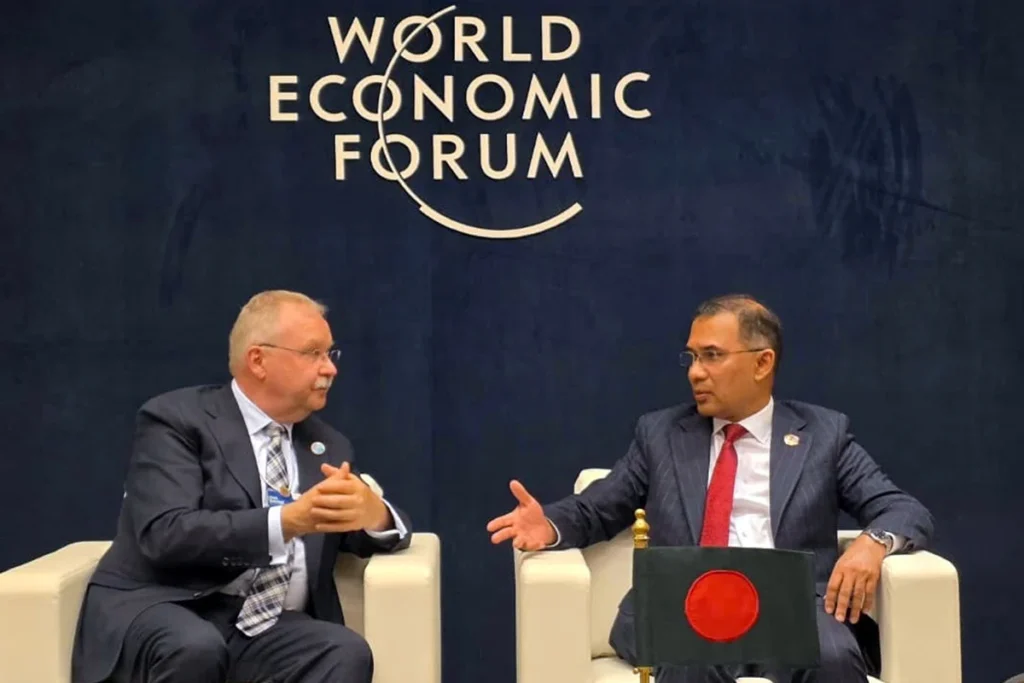
Prime Minister Tarique Rahman on Tuesday called on the World Economic Forum (WEF) to spearhead coordinated international measures to support climate-vulnerable countries, particularly low-lying delta nations like Bangladesh that face severe threats from rising sea levels and global warming. The Prime Minister made the call during a courtesy meeting with WEF President and Chief Executive Officer (CEO) Alois Zwinggi on Tuesday afternoon at the Dalian International Conference Center, held on the sidelines of the WEF’s annual gathering, according to an official press release.
At the commencement of the high-level meeting, WEF President Zwinggi extended his formal congratulations to Tarique Rahman on his assumption of office as the Prime Minister of Bangladesh. The subsequent dialogue centered on global environmental challenges, sustainable development pathways, and mechanisms to enhance financial and technical collaboration between international organizations and climate-exposed economies.
During the extensive discussion, the Prime Minister highly commended the World Economic Forum for its consistent initiatives and advocacy aimed at addressing the global climate crisis. However, he emphasized that the scale of the crisis requires a more robust, institutionalized coordinating framework. He urged the WEF to leverage its immense global network of policymakers, corporate leaders, and financial institutions to ensure that resources are directed efficiently toward countries experiencing the immediate and most devastating impacts of climate change.
Elaborating on the domestic front, Prime Minister Tarique Rahman outlined Bangladesh’s proactive climate adaptation and mitigation strategies, showcasing the nation’s transition from a position of vulnerability to one of resilience. He informed the WEF chief that the government has launched an ambitious environmental preservation programme targeting the plantation of 250 million trees across the country over the next five years. This massive afforestation drive aims to significantly enhance the national green cover, mitigate carbon emissions, and provide vital natural barriers against tropical cyclones and coastal erosion.
Furthermore, the Prime Minister highlighted a comprehensive hydrological restoration initiative designed to address the challenges of water management in the massive Bengal Delta. The government has undertaken plans for the strategic re-excavation of nearly 20,000 kilometers of rivers and canals nationwide. This widespread infrastructural intervention is expected to restore natural water flows, drastically reduce seasonal flood risks, improve navigational channels, and safeguard the livelihoods of millions of agricultural workers dependent on these water systems.
In addition to ecological restoration, the Prime Minister underscored Bangladesh’s accelerating transition toward green energy. He noted that the government has introduced comprehensive fiscal policies, including attractive tax incentives for solar power generation, to stimulate private sector participation and foreign direct investment in the renewable energy sector. Bangladesh has set a definitive target to source 20 percent of its total electricity demand from renewable energy infrastructure by the year 2030, a move aimed at reducing reliance on fossil fuels and ensuring long-term energy security.
The Prime Minister expressed confidence that Bangladesh’s transparent policy frameworks, coupled with its concrete actions in strengthening climate resilience and promoting sustainable development, would increasingly attract the attention of international financing institutions, multilateral development banks, and global impact investors.
In response, WEF President Alois Zwinggi assured the Prime Minister that the forum remains fully committed to supporting Bangladesh’s sustainable development goals. He stated that the specific climate and economic concerns raised by Bangladesh would receive due consideration within the forum’s strategic agendas. Acknowledging the critical role Bangladesh plays in global climate discourse, Zwinggi formally extended an invitation to Prime Minister Tarique Rahman to attend the upcoming WEF Annual Meeting in Davos, Switzerland, which serves as a premier global platform for world leaders to shape global, regional, and industry agendas.
The meeting was attended by a high-level Bangladeshi delegation, including Foreign Minister Dr. Khalilur Rahman, the Prime Minister’s Foreign Affairs Adviser Humaiun Kobir, the Executive Chairman of the Bangladesh Investment Development Authority (BIDA) Ashik Chowdhury, and the Prime Minister’s Additional Press Secretary Atikur Rahman Ruman.